What cloister actually meant
Enclosure was not a metaphor. It was a wall — and the women who nursed the sick had to be on the other side of it.

Enclosure was a canonical requirement with real physical consequences, and working in a public hospital was incompatible with it.
The rule and its architecture
When the Council of Trent closed in 1563, it did not merely tidy doctrine. Among its practical decrees was a firm restatement of clausura — canonical enclosure — for women in religious life. Every professed sister, the Council determined, was to remain within the physical bounds of her convent. The outside world could not enter; she could not leave. This was not a pious aspiration but an enforceable obligation, and the papacy had spent the decades since Trent trying to make it stick against centuries of irregular practice.
The consequences were architectural as much as spiritual. A cloistered house required a wall or grille separating the community from the street, a parlour fitted with screens for supervised contact with family, and a tour — a rotating wooden drum through which necessities could be passed without any direct encounter between inside and outside. Visitors who crossed the enclosure boundary without proper dispensation committed a canonical offence. The abbess who permitted it was answerable to her bishop. These were not guidelines; they were enforced.
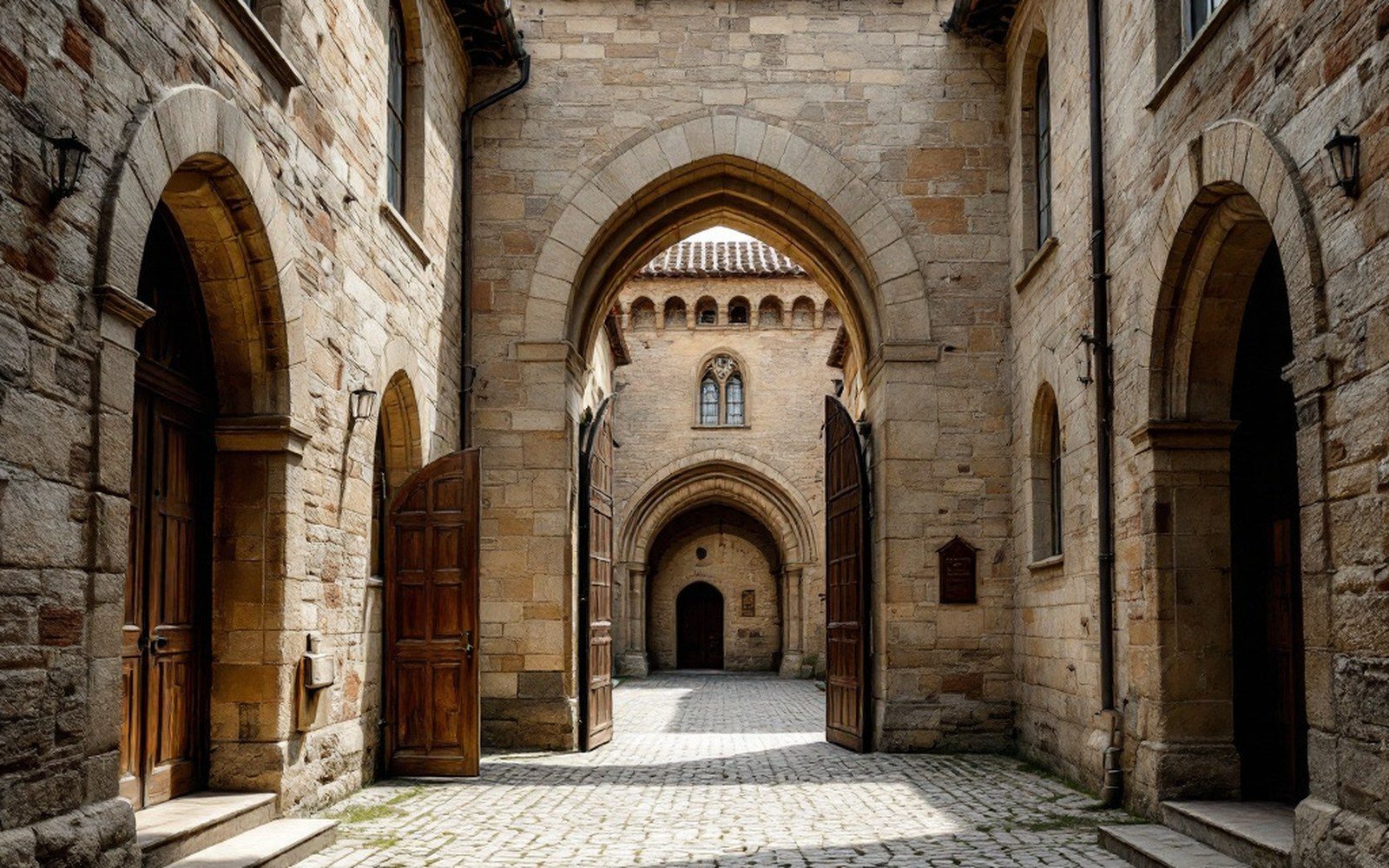
For a community of contemplatives whose purpose was choral prayer and whose recruits were typically drawn from families able to pay a dowry, the arrangement was workable, if sometimes financially precarious. But for women whose stated purpose was to go out and serve — to carry soup to the sick poor in their lodgings, to staff wards in a public hospital, to appear on doorsteps and in markets — enclosure was a structural impossibility. You cannot nurse a patient you cannot reach.
The problem the Daughters faced
When Vincent de Paul and Louise de Marillac began organising the women who would become the Daughters of Charity in the 1630s, the canonical question was immediate and sharp. A group of women living together, following a rule, wearing a habit and caring for the poor had every surface resemblance to a religious order — and religious orders of women were enclosed. Bishops and canon lawyers would expect the same of this group unless the situation was explicitly and formally arranged otherwise.
The solution arrived at in 1633 was unusual enough to need careful statement. The Daughters would not be a religious order. They would take no solemn, permanent vows. Instead, they renewed annual vows — simple promises made privately, without the canonical weight that would have triggered the enclosure rules. Without solemn profession, they were not technically nuns. Without being nuns, they could not be required to be cloistered. The logic was deliberate and the canonical ground had to be tested carefully, because the alternative — formal religious status — would have destroyed the institution's reason for existing. A cloistered Daughter of Charity could not be a Daughter of Charity at all.

What this meant in practice
The practical freedoms that followed from this arrangement were considerable. A sister could move through Paris ↗, enter the Hôtel-Dieu, cross a hospital ward, and discharge patients without violating any canonical boundary, because she had no enclosure wall. She could be transferred from one house to another — which is how the organisation eventually spread across France and, later, across Europe — without the elaborate episcopal permissions that governed a cloistered nun's movements.
None of this was frictionless. The lack of solemn vows meant the Daughters occupied an uncertain canonical category for much of the seventeenth century, and there were recurring pressures from local church authorities who saw a group of women in habit and wanted to classify — and enclose — them. Each time, the founding documents and the annual-vow arrangement held.
What cloister actually meant, in the end, was a choice between two incompatible forms of life. The 1633 arrangement was not a workaround or a compromise; it was the precondition for everything that followed — the wards, the ledgers, the transfers, the cornettes visible on hospital corridors rather than behind grilles. The wall that was not built is as significant as anything that was.